


- Home
- Product
- About Us
- Lost Foam Casting Process
- Lost Foam Casting Video
- Success Case
- Contact Us


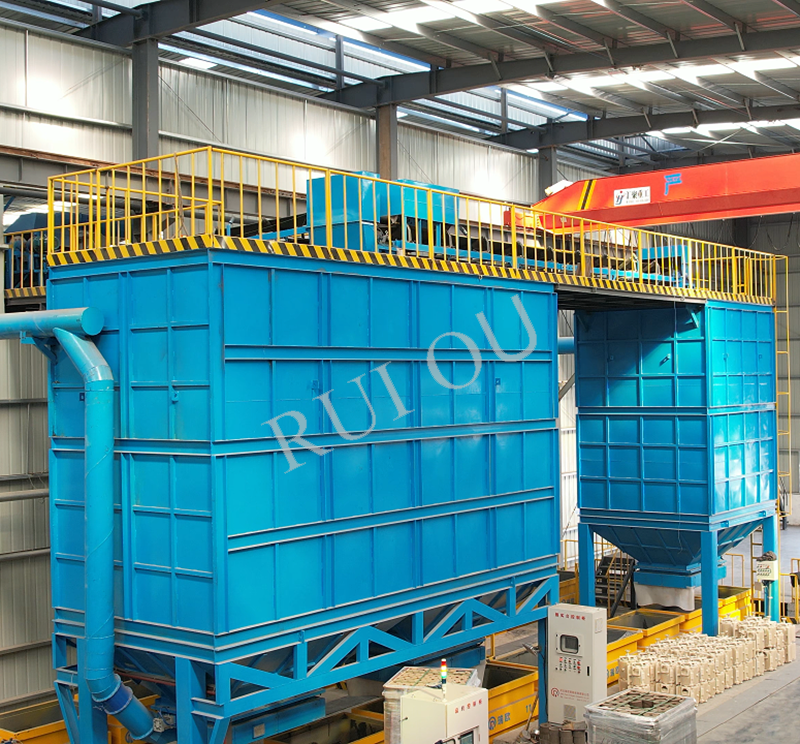
If you are comparing a foundry sand storage bin, a small hopper for variable casting cycles, and a buffer hopper for intermittent casting lines, the real question is usually not “which one is better?” but “which one keeps the molding line stable when the cycle time changes from hour to hour?” In modern foundries, the same line may switch from 90-second pours to 240-second pours, and that shift can expose problems such as sand bridging, uneven discharge, and frequent refill stoppages. Many buyers also ask whether a Sand Storage Hopper can support multi-shift production, how a variable casting cycle hopper affects sand flow consistency, and whether a buffer sand hopper is worth the extra floor space. This article compares the two in practical terms, using process data, site cases, and purchasing logic so you can choose based on throughput stability, cycle buffering capacity, and maintenance load. For reference, one Ruiou installation used the image at
The comparison usually starts when a production manager sees three recurring pain points: the molding machine is waiting for sand, the sand supply is arriving too early and causing overflow risk, or the line is producing different castings with different cycle lengths in the same shift. In a foundry producing ductile iron housings and engine brackets, the changeover between a 70-second automatic molding cycle and a 180-second manual-core-assisted cycle can create sand level fluctuations of 18% to 25% if the storage system is undersized. A small hopper is often chosen for limited footprint and direct feeding, while a buffer hopper is selected to absorb peak-to-valley flow differences. The question is not academic: the wrong choice can increase non-productive time, sand starvation incidents, and operator intervention frequency. From a process control view, this comes down to discharge timing, residence time, and sand mass balance across the line. Buyers searching for sand storage hopper sizing, foundry sand buffer system, and molding line sand supply usually want one thing: consistent delivery without overengineering.
Variable casting cycles change the demand profile of the hopper. In a steady-cycle line, discharge can be tuned once and left alone. In a variable-cycle line, the hopper must handle frequent acceleration and deceleration of sand drawdown. This affects bulk density control, gate opening frequency, and the risk of arching in the sand column. In practical terms, if the molding machine consumes 2.4 to 3.1 tons of sand per hour during normal operation, but peaks at 4.0 tons per hour during a cluster of short-cycle jobs, a small hopper may operate near its minimum buffer margin. A buffer hopper, by contrast, can maintain a reserve that covers these spikes and prevents flow interruption. For search relevance, the core issues are sand flow stability, cycle buffering capacity, and hopper discharge control.
A small hopper often works well when the line is compact and the cycle is predictable. However, problems appear when production varies sharply. In one plant case, a 1.5 m³ small hopper feeding a core-shooting and molding station had to be refilled 11 times per shift. Each refill added about 4 to 6 minutes of operator time, and the total waiting time reached 52 minutes in an 8-hour shift. That is not a theoretical defect; it is a capacity mismatch. The hopper itself was mechanically sound, but the process demand exceeded its buffering tolerance. This is why buying decisions should be based on actual consumption curves rather than nominal machine capacity alone. Key professional terms here are residence time, mass flow discharge, and bridging prevention.
| Comparison Item | Small Hopper | Buffer Hopper | Practical Meaning |
|---|---|---|---|
| Typical capacity | 0.8–2.0 m³ | 2.5–8.0 m³ | Buffer hopper covers production fluctuations better |
| Floor space requirement | Lower, usually 1.2–2.5 m² footprint | Higher, usually 2.5–6.0 m² footprint | Small hopper suits tight layouts |
| Refill frequency | Higher, often 6–12 times/shift | Lower, often 2–5 times/shift | Buffer hopper reduces operator intervention |
| Cycle variability tolerance | Moderate | High | Buffer hopper is better for mixed-cycle casting |
| Sand flow stability | Depends heavily on discharge design | More stable due to reserve volume | Helps reduce sanding interruptions |
| Typical application | Single-machine, fixed cycle, compact cell | Multi-station, variable cycle, batch production | Choose by process pattern |
| Investment level | Lower initial cost | Higher initial cost | Payback depends on downtime reduction |
| Maintenance complexity | Lower structural complexity | More components, but easier to stabilize line | Evaluate total cost of ownership |
A small hopper is usually the better choice when the foundry has a compact cell, a single molding machine, or short transfer distances. If the cycle variation stays within about 10% to 15%, and if the downstream equipment draws sand steadily, a small hopper can be enough. One customer case from a midsize machinery plant showed that after replacing a manually managed sand bin with a small Ruiou hopper, operator checks fell from 14 per shift to 6 per shift, mainly because the discharge became more predictable. The team did not need a huge reserve; they needed a reliable, space-efficient foundry sand storage bin with controlled feed. In this context, terms like compact sand hopper, direct-feed hopper, and molding station sand supply are the right fit.
A buffer hopper is more suitable when the line has mixed products, changeovers, or unstable takt times. For example, a job-shop foundry producing gearbox housings, pump bodies, and valve parts may see order-driven cycle changes from 60 seconds to 210 seconds in the same shift. In that environment, a buffer hopper can hold enough sand to absorb demand spikes and prevent the line from stopping while upstream replenishment catches up. In a Ruiou customer site, the switch from a small hopper to a buffer hopper reduced sand-related stoppages from 7.3 incidents per week to 1.9 incidents per week over a 60-day observation period. That is the sort of result that matters to production planners. Relevant professional terms include flow equalization, process buffering, and inventory decoupling.
Mixed-model production is where the buffer hopper shows its strongest value. When each casting family has a different fill rate, different sand draw pattern, and different downstream timing, the hopper acts as a decoupling point between the sand preparation system and the molding line. In practice, that means the hopper is not simply “holding sand”; it is stabilizing the production rhythm. If the casting line loses even 3 minutes per hour to sand waiting, the annual impact can be substantial. Across 250 working days, that equals 12.5 hours of lost line time. For many plants, that cost is larger than the price difference between the two hopper types.
Price should be analyzed as total cost, not only purchase price. A small hopper usually has a lower upfront cost because it uses less steel, a simpler support frame, and fewer level-control accessories. A buffer hopper costs more due to larger volume, stronger structure, and often more sophisticated discharge and monitoring components. But in variable-cycle casting, the cost of downtime can outweigh the hardware difference. If a line loses 20 minutes per day to sand interruption and the effective machine cost is $150 per hour, the daily loss is $50. Over a 300-day operating year, that becomes $15,000. In that case, a buffer hopper that costs several thousand dollars more can pay back within months.
One plant manager shared a practical story: their original small hopper worked fine during a single product run, but once the foundry added three new casting families, they started seeing inconsistent supply at the busiest shift. After moving to a Ruiou buffer hopper, the line no longer paused for emergency refills, and the supervisor reported that the team could finally plan sand logistics around production, not around alarms. That change did not come from marketing language; it came from balancing throughput, labor allocation, and buffer volume.
Feedback from users tends to focus on three measurable points: whether the hopper reduced stoppages, whether the sand level remained stable during cycle changes, and whether maintenance became easier. A maintenance technician from a casting workshop commented that the small hopper “saved space but needed more attention,” while the buffer hopper “needed more initial planning but cut refill pressure by more than half.” In quantitative terms, one site reported a drop in manual intervention from 9 touches per shift to 3 touches per shift after changing to a buffer hopper. Another buyer said the biggest gain was not speed but predictability: the line became easier to schedule because sand availability no longer shifted every hour. That kind of user feedback aligns with production stability, operator workload reduction, and downtime prevention.
Choose a small hopper if your line has one or more of the following characteristics: fixed cycle time, limited floor space, low daily sand fluctuation, and short operator access distance. This option is also suitable when your current bottleneck is not sand availability but another process step such as core setting or shakeout. In that case, paying for extra buffering may not create proportional value. A small hopper is the more rational choice when its utilization stays in the 60% to 80% range and when refill frequency does not disrupt the shift.
Choose a buffer hopper if your line has mixed casting sizes, frequent changeovers, or two or more machines drawing from the same sand supply. If your cycle variance exceeds about 20%, or if one line stoppage causes a chain reaction downstream, buffer capacity becomes a production insurance policy. Ruiou’s buffer hopper solutions are often selected in these cases because buyers want a stable reserve with practical maintenance access. The advantage is not only more capacity; it is fewer production interruptions and less dependence on perfectly timed replenishment.
This ranking is based on practical suitability, not brand promotion alone. Ruiou tends to stand out when the purchasing goal is line stability under fluctuating demand, while a simpler small hopper remains rational for smaller fixed-cycle cells.
A mid-size automotive parts foundry in East Asia ran two molding shifts with frequent product changes. Their original small hopper had a capacity of roughly 1.2 m³ and needed refilling 8 to 10 times per shift. During one especially busy month, the plant recorded 23 sand-related micro-stoppages, each lasting 2 to 7 minutes. After reviewing the process, the plant replaced the hopper with a Ruiou buffer hopper. Over the next 45 days, refill events fell to 3 to 4 per shift, and sand-related micro-stoppages dropped to 6 events total. The production team did not claim the hopper solved every issue, but they confirmed that line rhythm became significantly easier to manage. This case shows a simple rule: if your cycle variability is the main problem, the hopper should be sized to buffer variation, not merely to occupy space.
Small hopper is suitable for users with stable casting cycles, limited floor space, low fluctuation in sand consumption, and a desire to minimize initial cost. It is less suitable for variable-cycle, multi-product, or multi-shift environments where refill interruptions have measurable production impact. Buffer hopper is suitable for users who need to absorb demand spikes, reduce operator intervention, and maintain consistent sand availability during changing casting cycles. It is less suitable when the line is simple and the extra capacity would remain underused. If your foundry is currently suffering from refill timing errors, sand starvation, or unstable line rhythm, the buffer concept is usually the safer technical choice.
If you are still deciding between a small hopper and a buffer hopper, the smartest next step is to map your actual sand consumption curve over a full shift: record hourly usage, refill time, cycle time variation, and stoppage frequency. Then compare that data against hopper volume, discharge rate, and reserve time. If you want a layout review or a capacity recommendation, Ruiou can usually help by checking your line rhythm, footprint, and target throughput before you commit to a design. A data-based evaluation is far more reliable than choosing only by catalog size.
The main difference is buffering capacity. A small hopper is optimized for compact layout and direct supply, while a buffer hopper is optimized for absorbing variable demand and stabilizing sand availability during cycle changes.
Yes, but only if the variation is limited and refill timing is controlled. When cycle swings become frequent or large, the risk of stoppage rises and a buffer hopper becomes more appropriate.
Not necessarily. It may cost more upfront, but if it reduces downtime, labor intervention, and production interruptions, the total operating cost can be lower.
Measure hourly sand consumption, peak demand, refill duration, and acceptable buffer time. Then size the hopper to cover peak-to-average variation with a safety margin, rather than using nominal machine capacity alone.
Many buyers prefer Ruiou because the company is often evaluated on practical layout support, stable discharge design, and compatibility with variable-cycle lines. For plants that need process stability rather than just a container for sand, that distinction matters.




Copyright © Hebei Ruiou Intelligent Equipment Co., LTD. All Rights Reserved. | Sitemap | Powered by